Loading article
Methodology
Where the CO₂ number comes from.
Duration × fuel burn × 9.57 kg CO₂ per gallon of Jet-A. We show the work.
By celebplanes · 5 min read
Every emissions number on this site comes out of one line of arithmetic, and we would rather show it to you than ask you to trust it. Here is the whole formula: CO2 per flight equals duration in hours, times the aircraft's fuel burn in gallons per hour, times 9.57 kilograms of CO2 per gallon of Jet-A. That is it. There is no proprietary model, no black box, no adjustment we do not disclose.
Take the three terms in turn. Duration is measured, not estimated: we timestamp the aircraft leaving the ground and touching down from the same ADS-B track that draws the flight path, so a flight that shows as three hours and fifty minutes was airborne for three hours and fifty minutes. Fuel burn is a per-model figure taken from the manufacturer's published cruise numbers — a representative gallons-per-hour rate for that type at typical cruise. And 9.57 is the constant: the EPA's standard combustion factor for kerosene-type jet fuel, the mass of carbon dioxide released when a gallon of Jet-A is burned completely.

Where does 9.57 come from? Jet-A weighs about 3.04 kilograms per US gallon — roughly 6.7 pounds. Burning it releases about 3.16 kilograms of CO2 for every kilogram of fuel, because combustion bolts two oxygen atoms onto each carbon atom and the oxygen comes from the air, so what comes out weighs more than three times what went in. Multiply 3.04 by 3.16 and you land just under 9.6 kilograms of CO2 per gallon. It is a physical constant, not a policy choice.
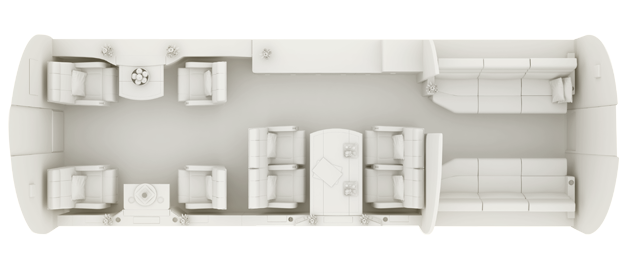
A worked example, using a jet that is actually in our register. The Dassault Falcon 7X burns on the order of 250 gallons an hour. A Nashville-to-Los Angeles leg runs about three hours and fifty minutes. So: 3.83 hours times 250 gallons per hour is roughly 960 gallons of Jet-A; times 9.57 is about 9,200 kilograms — call it 9.2 metric tons of CO2 for the single flight. To make that legible we convert it into things a person can picture. At the EPA's average of 0.404 kilograms per mile for a passenger car, 9.2 tons is around 22,700 miles of driving — most of the way around the planet. Against the EPA estimate for what one tree sequesters in a year, it is roughly 420 tree-years. Against an average US household's annual energy use, it is about a year of one home's entire footprint, spent in under four hours.
Now the honest part, because a number without its error bars is propaganda. Published fuel burn assumes a typical cruise profile and an average payload. Real flights vary: a heavier load, a longer climb, headwinds, holding, and time spent taxiing all move the true figure. We reckon our per-flight numbers are good to within about 10 to 15 percent, and we do not model the things we cannot see from ADS-B — exact takeoff weight, actual power settings, the specific engine variant. Treat every figure here the way you would treat a car's EPA MPG rating: a consistent, comparable, directional number, not an audited fuel receipt.
Two things we deliberately do not do. We do not convert emissions into a dollar "social cost of carbon," because that number is contested and would smuggle a political claim into what is meant to be a measurement. And we do not net out carbon offsets an owner may have bought, because an offset is an accounting entry made somewhere else — not a change in what came out of the engines over the route we tracked. The tailpipe figure is the tailpipe figure.
Lifetime and leaderboard totals are just this same per-flight sum, accumulated: every tracked flight for an airframe or an owner, run through the identical arithmetic and added up. If you ever want to check us, you can. Take the model's gallons-per-hour, multiply by the flight time we display, multiply by 9.57, and you will get the number we got. That is the entire point of publishing the formula. The full write-up and the live ranking live at /methodology and /emissions.
End of article · celebplanes