Ilyushin Il-96-300
RA-96014 · ICAO: N/A · Airliner jet
Fuel burn
1100 gal/hr
CO₂ per hour
10,567 kg
Car miles equiv.
26,156
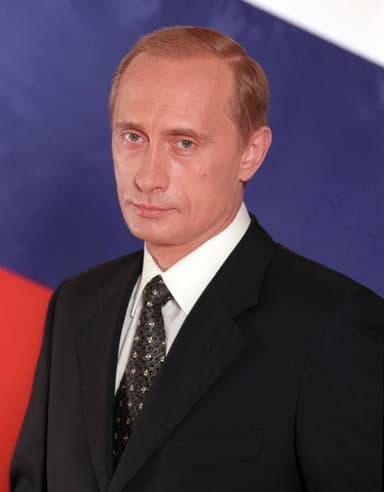
Vladimir Putin has served as President of Russia since 2000 (with a 2008–12 gap as Prime Minister). His VIP air fleet is operated by Special Flight Detachment "Russia," based at Vnukovo-2 (UUWW), the Kremlin's dedicated terminal outside Moscow.
The primary aircraft are Ilyushin Il-96-300 four-engine widebodies — Russian-built and deliberately chosen over Western jets to avoid foreign dependency. Serials RA-96014 through RA-96025 form the current fleet; RA-96022 and RA-96023 are the newest, delivered 2021–22. The fleet is supplemented by Airbus A319-115 ACJs (RA-73025/26) for shorter-range official travel, Antonov An-148s, Sukhoi Superjets, and Tupolev Tu-204/214s for government transport.
Putin's exact aircraft is rarely confirmed in advance for security reasons; the Il-96s operate under the RSD callsign series (RSD001–RSD999). Post-2022 sanctions have degraded spare-parts availability for the A319s but the Il-96 remains fully domestically supportable.
Note · We track Vladimir Putin / Russian Presidential Flight's planes, not Vladimir Putin / Russian Presidential Flight in person. Flight data shows when and where each plane flew. It does not show who was on board.
We do not see it in the air right now. The last flight we tracked for Vladimir Putin / Russian Presidential Flight's Ilyushin Il-96-300 (RA-96016) landed at Severniy veter (ULSW) on October 9, 2026. Follow it on the live jet tracker map.
The map shows where Vladimir Putin / Russian Presidential Flight's planes have flown. Each dot is a recorded position.
Over the last 16 completed flights we tracked, Vladimir Putin / Russian Presidential Flight's planes spent about 37 hours in the air. We estimate those flights put out 362.4 metric tons of CO₂.
Total flights
16
Total CO₂
362.4t
Flight hours
37h
We track 6 planes for Vladimir Putin / Russian Presidential Flight. Each one is listed below with its tail number and hourly CO₂.
These are the last 16 flights we tracked for Vladimir Putin / Russian Presidential Flight's planes, newest first. Open a flight to see its route map, time in the air, top altitude and speed.
Vladimir Putin / Russian Presidential Flight flies these planes: Ilyushin Il-96-300 and Airbus A319-115 ACJ. The tail numbers are RA-96014, RA-96016, RA-96022, RA-96023 and 2 more. You can track each one live on this page, along with its flight history and CO₂.
Vladimir Putin / Russian Presidential Flight flies an Ilyushin Il-96-300, tail number RA-96014. It is an airliner. We also track 5 more planes on this page: Ilyushin Il-96-300 (RA-96016), Ilyushin Il-96-300 (RA-96022), Ilyushin Il-96-300 (RA-96023), Airbus A319-115 ACJ (RA-73025) and Airbus A319-115 ACJ (RA-73026).
Vladimir Putin / Russian Presidential Flight's planes have these tail numbers: RA-96014 (Ilyushin Il-96-300), RA-96016 (Ilyushin Il-96-300), RA-96022 (Ilyushin Il-96-300), RA-96023 (Ilyushin Il-96-300), and 2 more. Each tail number links to a live tracking page. There you can see the plane's flight history, fuel burn and CO₂.
About 10,567 kg for every hour in the air. Vladimir Putin / Russian Presidential Flight's Ilyushin Il-96-300 (RA-96014) burns roughly 1,100 gallons of jet fuel an hour. That is about the same CO₂ as driving an average car 26,156 miles.
Vladimir Putin / Russian Presidential Flight's home airport is Vnukovo Intl (Moscow) (UUWW / VKO). Frequent stops include ULLI, URSS, UWWW and XLLL.
Owner matches come from the FAA registry, adsb.lol (ODbL) and ADSB.fi data, and SEC filings. They may be incomplete or out of date. Methodology · Report an error. For observational use only.
RA-96022 · ICAO: N/A · Airliner jet
RA-96023 · ICAO: N/A · Airliner jet
RA-73025 · ICAO: N/A · Airliner jet
RA-73026 · ICAO: N/A · Airliner jet
About 362.4 metric tons of CO₂ over 16 tracked flights and 37 hours in the air. We start with the flight times from public ADS-B data. We multiply each hour by the maker's fuel burn figure. Then we apply the EPA standard of 9.57 kg of CO₂ per gallon of jet fuel.
Yes. The FAA requires planes with transponders to broadcast their position over ADS-B, and the signal is not encrypted. We collect that public data from adsb.lol and ADSB.fi, two open flight-tracking networks. News outlets and university researchers use the same kind of data. Our methodology page explains how it works.