Boeing 747-800 BBJ
TC-TRK · ICAO: N/A · Airliner jet
Fuel burn
1400 gal/hr
CO₂ per hour
13,449 kg
Car miles equiv.
33,290
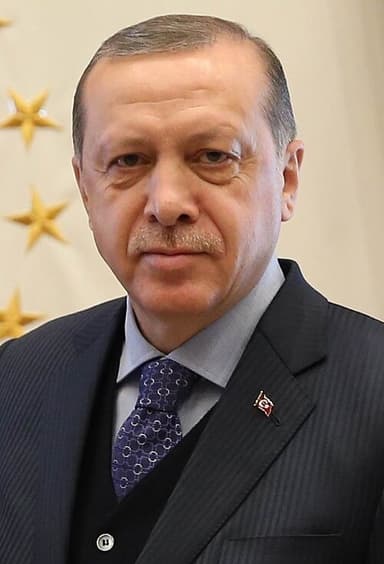
President Recep Tayyip Erdogan has dominated Turkish politics since 2002, first as Prime Minister then President. Turkey is a NATO member with ambitions of strategic autonomy, making Erdogan one of the most diplomatically active heads of state globally — shuttle diplomacy between Moscow, Kyiv, Riyadh, Tehran, and Washington.
The primary aircraft is the Boeing 747-800 BBJ TC-TRK — a full-double-deck VIP configuration capable of non-stop intercontinental range. The Airbus A340-500 TC-CAN and A330-200 TC-TUR serve as alternates or carry the official delegation when the president travels separately from the main party. Multiple Gulfstream G550s (TC-ATA, TC-CBK, TC-DAP) and an A318 ACJ Elite handle ministerial missions.
Erdogan's flight movements are closely watched by foreign intelligence services and aviation enthusiasts alike; his aircraft's ADS-B frequently toggles off/on during politically sensitive missions.
Note · We track Recep Tayyip Erdogan / Turkish Presidential Flight's planes, not Recep Tayyip Erdogan / Turkish Presidential Flight in person. Flight data shows when and where each plane flew. It does not show who was on board.
We do not see it in the air right now. The last flight we tracked for Recep Tayyip Erdogan / Turkish Presidential Flight's Airbus A340-500 (TC-CAN) landed at Akıncı Air Base (LTAE) on October 12, 2026. Follow it on the live jet tracker map.
The map shows where Recep Tayyip Erdogan / Turkish Presidential Flight's planes have flown. Each dot is a recorded position.
Over the last 16 completed flights we tracked, Recep Tayyip Erdogan / Turkish Presidential Flight's planes spent about 32 hours in the air. We estimate those flights put out 169.2 metric tons of CO₂.
Total flights
16
Total CO₂
169.2t
Flight hours
32h
We track 4 planes for Recep Tayyip Erdogan / Turkish Presidential Flight. Each one is listed below with its tail number and hourly CO₂.
These are the last 16 flights we tracked for Recep Tayyip Erdogan / Turkish Presidential Flight's planes, newest first. Open a flight to see its route map, time in the air, top altitude and speed.
Recep Tayyip Erdogan / Turkish Presidential Flight flies these planes: Boeing 747-800 BBJ, Airbus A340-500, Airbus A330-200 Prestige and Gulfstream G550. The tail numbers are TC-TRK, TC-CAN, TC-TUR and TC-ATA. You can track each one live on this page, along with its flight history and CO₂.
Recep Tayyip Erdogan / Turkish Presidential Flight flies a Boeing 747-800 BBJ, tail number TC-TRK. It is an airliner. We also track 3 more planes on this page: Airbus A340-500 (TC-CAN), Airbus A330-200 Prestige (TC-TUR) and Gulfstream G550 (TC-ATA).
Recep Tayyip Erdogan / Turkish Presidential Flight's planes have these tail numbers: TC-TRK (Boeing 747-800 BBJ), TC-CAN (Airbus A340-500), TC-TUR (Airbus A330-200 Prestige), TC-ATA (Gulfstream G550). Each tail number links to a live tracking page. There you can see the plane's flight history, fuel burn and CO₂.
About 13,449 kg for every hour in the air. Recep Tayyip Erdogan / Turkish Presidential Flight's Boeing 747-800 BBJ (TC-TRK) burns roughly 1,400 gallons of jet fuel an hour. That is about the same CO₂ as driving an average car 33,290 miles.
Recep Tayyip Erdogan / Turkish Presidential Flight's home airport is Istanbul Airport (LTFM / IST). Frequent stops include LFPB, OERK, OMDB and UUWW.
Owner matches come from the FAA registry, adsb.lol (ODbL) and ADSB.fi data, and SEC filings. They may be incomplete or out of date. Methodology · Report an error. For observational use only.
TC-TUR · ICAO: N/A · Airliner jet
TC-ATA · ICAO: N/A · Heavy jet
About 169.2 metric tons of CO₂ over 16 tracked flights and 32 hours in the air. We start with the flight times from public ADS-B data. We multiply each hour by the maker's fuel burn figure. Then we apply the EPA standard of 9.57 kg of CO₂ per gallon of jet fuel.
Yes. The FAA requires planes with transponders to broadcast their position over ADS-B, and the signal is not encrypted. We collect that public data from adsb.lol and ADSB.fi, two open flight-tracking networks. News outlets and university researchers use the same kind of data. Our methodology page explains how it works.